Chess lessons › Chess strategy
The backward pawn
A pawn left behind by its neighbours has no pawn to protect it, and the square in front of it is an outpost.
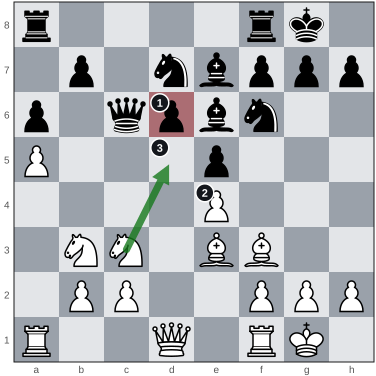
The idea
A pawn left behind by its neighbours, with an outpost in front of it.
- No black pawn stands beside or behind the pawn on d6.
- White’s pawn on e4 guards d5, the square in front of it.
- On d5 a white knight can never be chased away by a pawn.
In a game: Look for an enemy pawn left behind on a half-open file, and the square in front of it.
How the lesson begins
A backward pawn has no pawn of its own beside it or behind it to protect it, and it cannot safely step forward, because an enemy pawn guards the square in front of it.
This is the Najdorf Sicilian, from Vasily Smyslov against Mikhail Tal, Candidates Tournament 1959. Watch Black’s d-pawn.
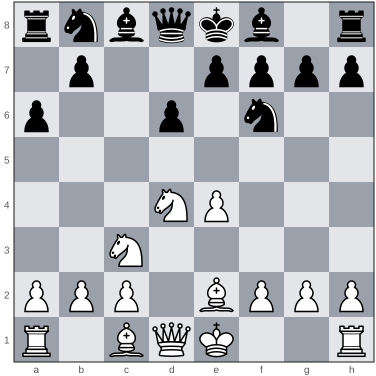
- 6... e5 Black’s e-pawn steps past the pawn on d6. Black has no c-pawn, so now no pawn can ever protect d6.
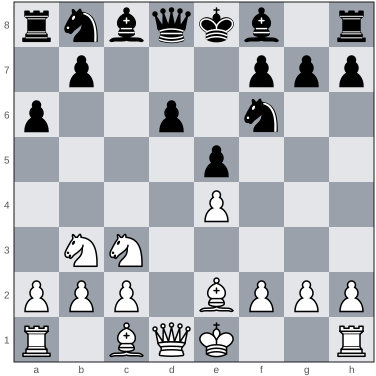
- 7. Nb3 The knight retreats. The pawn on d6 is backward: White’s pawn on e4 guards d5, the square in front of it. And the d-file is half-open for White, so White’s rooks can attack d6 along it.
A question
Black made the pawn on d6 backward on purpose, by pushing the e-pawn to e5. What does Black get in return?
Show the answer
The pawn on e5 drove White’s knight away from d4, and it controls d4 and f4.
Right. The knight had to leave the centre, and the engine rates the position as about level. A backward pawn is only a problem when the opponent can use the square in front of it or win the pawn.