Chess lessons › Chess strategy
The Benoni structure
White has the centre and Black the queenside: how each side uses its extra pawns.
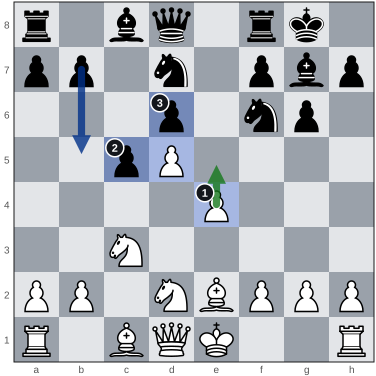
The idea
White has the centre, Black the queenside: each side plays to use it.
- White has two centre pawns, d5 and e4, against Black’s d6.
- Black has three queenside pawns against two, and pushes ...b5 and ...c4.
- The d6 pawn cannot go forward, so White breaks with e5 to attack it.
In a game: White pawns on d5 and e4 against c5 and d6, with no white c-pawn and no black e-pawn.
How the lesson begins
This pawn shape is called the Benoni structure. White has pawns on d5 and e4. Black has pawns on c5 and d6, and no e-pawn, while White has no c-pawn. So the c-file is half open for White’s rooks and the e-file for Black’s.
Each side has a majority, more pawns than the other has in one area. In the centre White has two pawns (d5 and e4) against one (d6). On the queenside Black has three (a7, b7 and c5) against two (a2 and b2). Each side plays to use its majority.
This is Spassky v Fischer, the 1972 World Championship match.
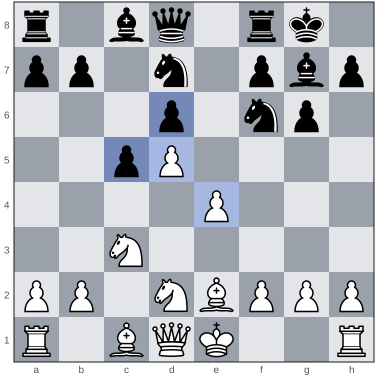
A question
Count the pawns on each side of the board. Which sentence is true?
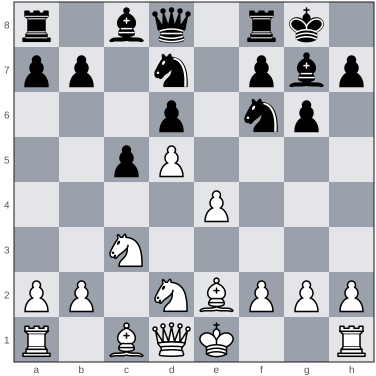
Show the answer
White has the majority in the centre, and Black on the queenside..
Yes. In the centre it is two pawns against one for White, on the queenside three against two for Black. On the kingside it is three against three.