Chess lessons › Chess strategy
The Sicilian small centre
Black’s pawns on d6 and e6 are solid, and Black breaks with ...b5, ...d5 or ...e5.
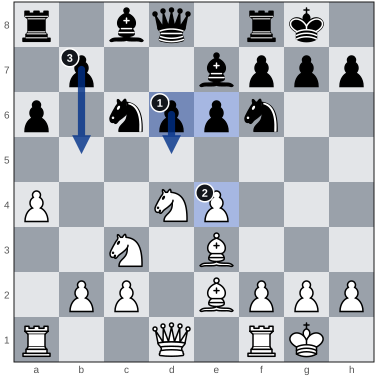
The idea
Pawns on d6 and e6 hold; Black breaks with ...b5, ...d5 or ...e5.
- Black’s pawns on d6 and e6 guard c5, e5, d5 and f5.
- White tries f4, g4 and e5 to break through on the kingside.
- Black answers with ...b5, ...d5 or ...e5 before the attack arrives.
In a game: Black pawns on d6 and e6, no c-pawn for Black and no d-pawn for White.
How the lesson begins
In the Open Sicilian White has traded his d-pawn for Black’s c-pawn. Black has set up pawns on d6 and e6, side by side, while White keeps the pawn on e4. This is the Scheveningen set-up, and the pawns are the small centre.
Black’s two pawns guard c5, e5, d5 and f5, so White’s pieces cannot easily settle on those squares. White has the half-open d-file and Black the half-open c-file.
This is Topalov v Kasparov, Yerevan 1996.
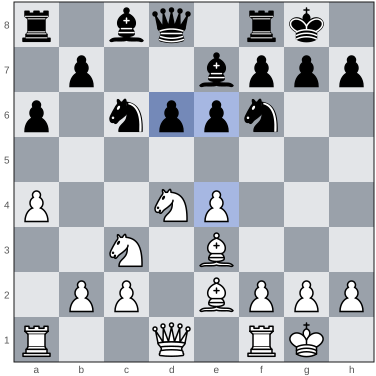
A question
Which answer lists all the squares Black’s pawns on d6 and e6 attack?
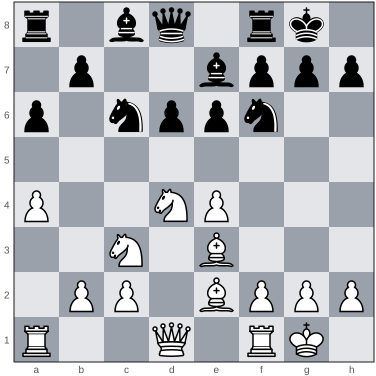
Show the answer
c5, e5, d5 and f5..
Yes. A pawn captures diagonally. For Black, d6 hits c5 and e5, and e6 hits d5 and f5. White’s pieces cannot use any of these squares without being challenged by a pawn.