Chess lessons › Chess strategy
Restricting the opponent’s pieces
Take squares away from an enemy piece with pawns first, until it has nowhere useful to go.

The idea
Take squares from a piece with pawns until it has nowhere safe to go.
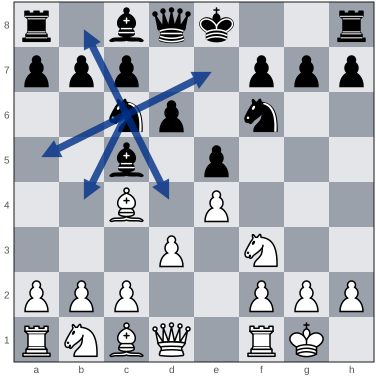
- The pawn on c3 attacks b4 and d4, the knight’s two forward squares.
- The knight on c6 keeps a5, b8 and e7, but a pawn now covers its forward squares.
- A pawn guards a square cheaply: a knight that lands there can be taken.
In a game: Ask which squares the enemy piece wants, then cover them with a pawn.
How the lesson begins
A piece is worth the squares it can use. Restricting a piece means taking those squares away, so it cannot do its job.
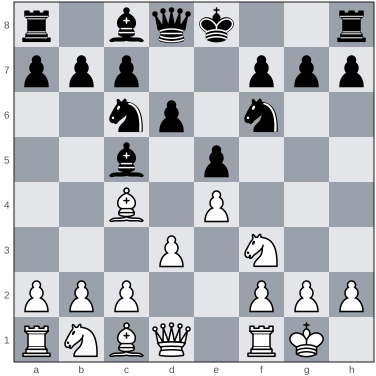
Look at Black’s knight on c6. It has five moves: a5, b4, b8, d4 and e7. Two of them, b4 and d4, take it forward into White’s half of the board. White is to move and wants to cover both.
Find the move
Which pawn move attacks both b4 and d4?
A hint
The pawn on c2 can step forward one square.
Show the answer
6. c3
c3. The pawn attacks b4 and d4 at once, so a knight that lands on either square can be taken by a pawn. The engine has c3 among its top choices here, and it prepares d4.
In numbers
In the puzzle bank
707 puzzles in GreyChess’s bank practise it. Half of them are rated between 1,219 and 2,304.
The piece that makes the first move of the answer: bishop 25%, rook 20%, pawn 16%, queen 14%, knight 14%, king 13%, in puzzles from the Lichess puzzle database.