Chess lessons › Chess strategy
The blockade
Stop a passed pawn by putting a piece on the square in front of it: a knight does the job best.

The idea
Stop a passed pawn with a piece on the square in front of it.
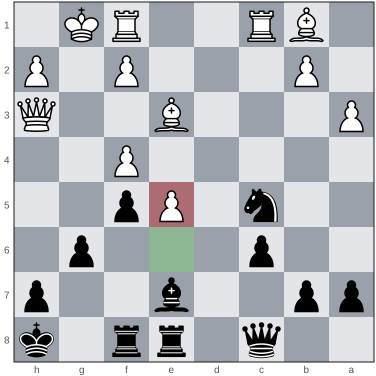
- White’s pawn on e5 is passed: no black pawn can stop it.
- The knight goes to e6, the square right in front of the pawn.
- The pawn on f5 stops White’s f-pawn, so no white pawn can chase the knight away.
In a game: When your opponent has a passed pawn, look for a safe square in front of it for a knight.
How the lesson begins
A passed pawn wants to run to the end of the board. The surest way to stop it is to put a piece on the square right in front of it. This is called a blockade, and the piece is the blockader.
This is Joseph Henry Blackburne against Mikhail Chigorin, Monte Carlo 1901. White’s pawn on e5 is passed: no black pawn stands ahead of it, on its own file or on the files beside it. The square in front of it is e6.
Find the move
Black to move. Put a piece on the blockade square.
A hint
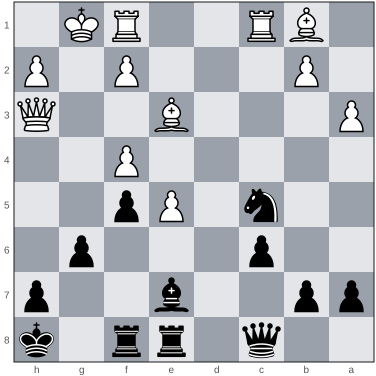
Which square is right in front of the pawn on e5? Your knight can reach it in one move.
Show the answer
25... Ne6
Ne6 stops the pawn for good. White has no d-pawn, and Black’s pawn on f5 stops White’s f-pawn, so no white pawn can chase the knight away. From e6 the knight still works: it attacks f4 and d4. It is the engine’s first choice.