Chess lessons › Chess strategy
Rook against two minor pieces
Two minor pieces usually beat a rook, often even a rook and a pawn: count before you trade.
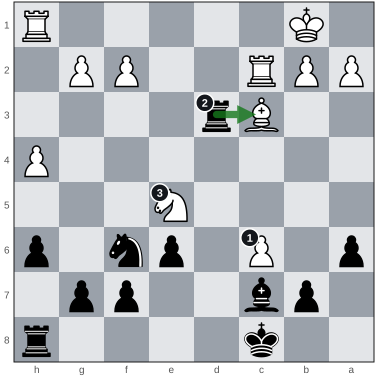
The idea
Two minor pieces usually beat a rook, often a rook and a pawn too.
- White threatens cxb7+, taking a pawn with check.
- Black’s rook takes the bishop on c3 instead.
- After cxb7+ Kxb7 Rxc3, the bishop takes the knight on e5.
In a game: Before you trade two minor pieces for a rook, ask what the pieces will do afterwards.
How the lesson begins
In points, a rook is 5 and a bishop or a knight is 3 each, so two minor pieces make 6. Players often count two minor pieces as roughly a rook and a pawn. In the middlegame the two pieces are usually worth more than that, because they attack and guard different squares at once.
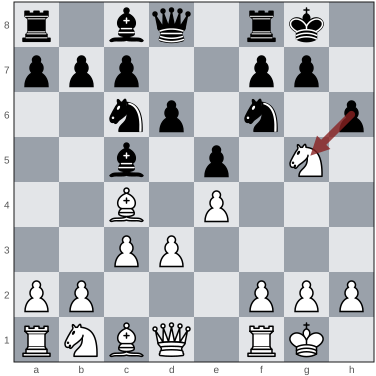
This position comes from an Italian Game. White’s knight on g5 is attacked by the pawn on h6.
A question
White can play Nxf7, and after Rxf7 Bxf7+ Kxf7 White has a rook and a pawn for two minor pieces. Is that a good trade here?
Show the answer
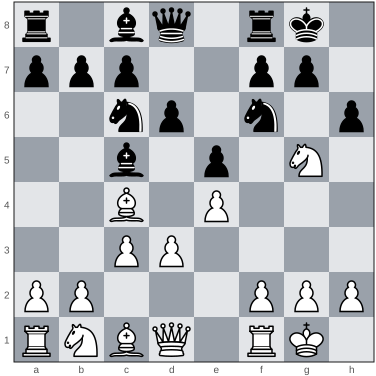
No. Retreating with Nf3 is much better; after the trade Black’s two pieces are worth more.
Right. The engine likes the quiet Nf3 best, and after the trade it puts Black about two pawns ahead.