Chess lessons › Chess strategy
The Caro-Kann and Slav structure
A pawn on c6 holds d5 and lets the light bishop out before ...e6; then ...c5 or ...e5 frees the game.
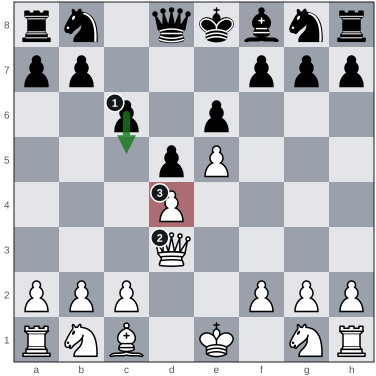
The idea
A pawn on c6 holds d5; the light bishop comes out before ...e6.
- The pawn on c6 holds d5, so Black keeps a pawn in the centre.
- The light bishop left before ...e6 and was traded on d3.
- Next ...c5 attacks d4, the base of White’s chain.
In a game: Before you play ...e6, ask whether your light-squared bishop is still inside the pawns.
How the lesson begins
In the Slav Defence (1.d4 d5 2.c4 c6) and the Caro-Kann (1.e4 c6 2.d4 d5), Black guards the d5-pawn with the c-pawn. If White ever takes on d5, Black takes back with a pawn and keeps a pawn in the centre.
This is Johannes Zukertort against Wilhelm Steinitz, from the first world championship match, 1886. Step through Black’s next moves.
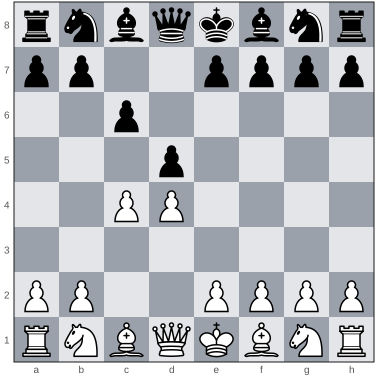
- 3. e3 Bf5 The light-squared bishop comes out first.
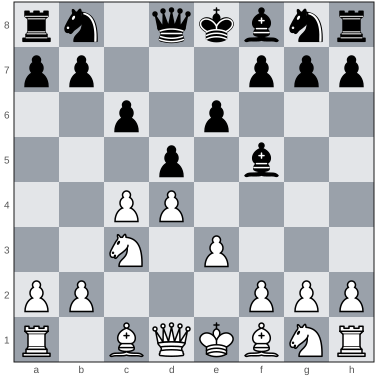
- 4. Nc3 e6 Only now does the e-pawn move, and the bishop is already outside the pawns.
A question
Why did Black play ...Bf5 before ...e6?
Show the answer
After ...e6 the pawn on e6 would block the bishop on c8 in.
Right. The bishop on c8 leaves by d7, e6 and beyond. Once a pawn stands on e6 that road is shut. In the Queen’s Gambit Declined (2...e6) this bishop is often Black’s problem piece.