Chess lessons › Chess strategy
The Stonewall
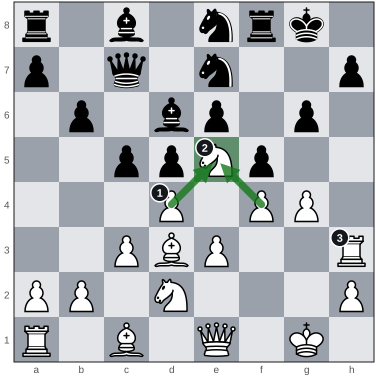
Pawns on c3, d4, e3 and f4 give a knight the e5 square, but leave a hole on e4 and a bishop shut in.
The idea
Pawns on c3, d4, e3 and f4 give a knight e5 but leave a hole on e4.
- The pawns on d4 and f4 both guard e5.
- Black’s f-pawn has gone to f5, so no black pawn can chase the knight.
- The rook lifted to h3 joins the attack on the king.
In a game: With pawns on d4 and f4, aim a knight at e5; watch for enemy pieces landing on e4.
How the lesson begins
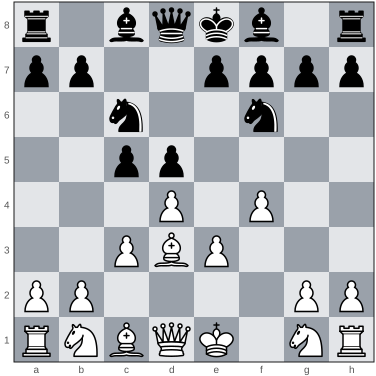
The Stonewall is a pawn set-up: White’s pawns stand on c3, d4, e3 and f4, like a wall across the centre. Black can build the same wall with the c, d, e and f pawns.
This is Jackson Showalter against Dawid Janowski, from their match in Brooklyn, 1899. Step through the moves and watch White build the wall.
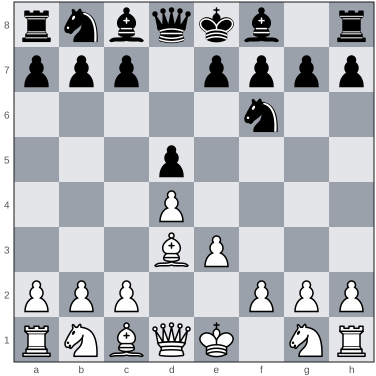
- 3... c5 4. c3 Nc6 5. f4 The wall is complete: pawns on c3, d4, e3 and f4.
A question
Look at the wall. Which square in Black’s half does it give White, that two white pawns protect?
Show the answer
e5: the pawns on d4 and f4 both guard it.
Right. A white piece on e5 has two pawns behind it. That square is the reward for building the wall.