Chess lessons › Chess strategy
Counter-attack as defence
Before you defend, look for a bigger threat of your own: a blow in the centre or a move that attacks back.

The idea
Meet an attack with a bigger threat of your own.
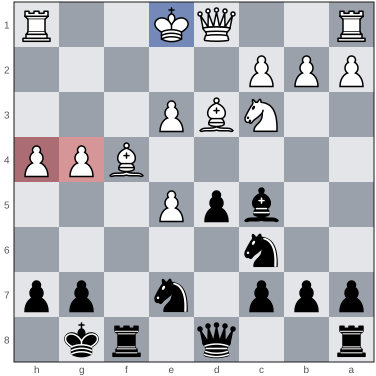
- White has pushed the g- and h-pawns at Black’s king.
- White’s own king is still in the centre on e1.
- d4 attacks c3 and e3 and opens lines in the middle.
In a game: Before you defend, look for a check, a capture or a central pawn break of your own.
How the lesson begins
Defence does not always mean passive moves. Often the best answer to an attack is a counter-attack: a threat of your own that is bigger than your opponent’s. An old rule says: a flank attack is best met by a blow in the centre.
This is John Owen against Joseph Henry Blackburne, Bradford 1888. White has pushed the g- and h-pawns towards Black’s king, but White’s own king is still in the centre on e1.
Find the move
Black to move. Hit back in the centre.
A hint
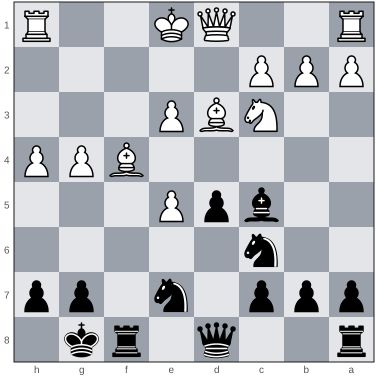
Which pawn can strike at White’s centre and attack a piece at the same time?
Show the answer
13... d4
d4 attacks the knight on c3 and the pawn on e3, and starts to open lines towards White’s king on e1. It is the engine’s first choice.