Chess lessons › Chess strategy
Pawn islands
Count your groups of pawns: fewer islands mean fewer pawns that only pieces can protect.
The idea
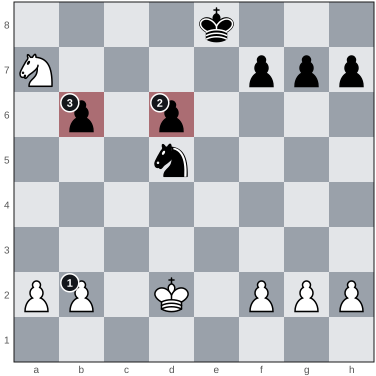
Count your pawn groups: fewer islands are easier to defend.
- White’s pawns stand in two groups, or islands.
- Black’s stand in three, and the pawns on b6 and d6 are each alone.
- No pawn can protect a lone pawn, so pieces must do it.
In a game: Before a pawn capture, count the islands you will have after it.
How the lesson begins
A pawn island is a group of your pawns on files next to each other. A file with none of your pawns ends one island, and the next pawn along starts another.
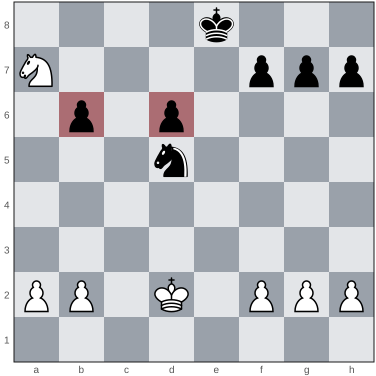
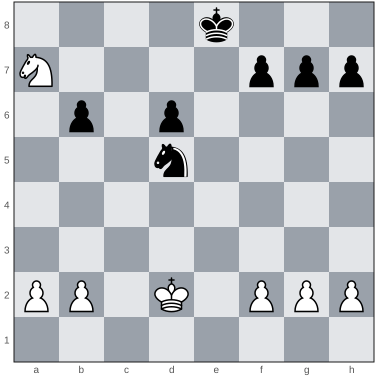
This knight ending is from Alexander Alekhine against Erik Andersen, Folkestone Olympiad 1933. White has two islands: the a and b-pawns, and the f, g and h-pawns. Black has three: the pawn on b6, the pawn on d6, and the f, g and h-pawns. A pawn that makes an island on its own, like b6 or d6, is an isolated pawn.
A question
Some chess teachers credit the idea of pawn islands to the world champion José Raúl Capablanca. Here is why it matters. A pawn protects only the two squares diagonally in front of it, so a pawn can be protected by another pawn only from the next file, one rank behind. In any island, which pawn can no pawn protect?
Show the answer
The one furthest back.
Right. A pawn that could protect the back pawn would stand on the next file, further back, and so it would belong to the same island. So the back pawn has no protector, and every island has a pawn that only pieces can protect. Each extra island gives your pieces one more to watch.