Chess lessons › Chess strategy
Weak colour complexes
When the bishop of one colour is gone, the squares of that colour become holes for the other side.
The idea
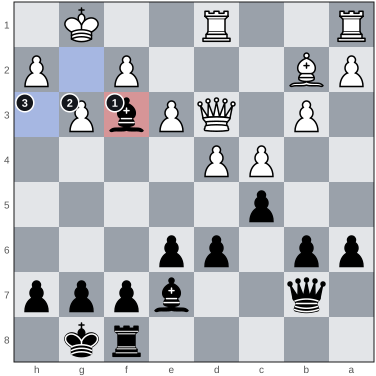
Lose the bishop of one colour, and those squares become holes.
- Black’s bishop sits on f3, a light square no white pawn can attack.
- White’s pawns on e3, f2, g3 and h2 all stand on dark squares.
- White has no light-squared bishop left to guard g2 or h3.
In a game: When a bishop is traded, look at the squares of its colour around your king.
How the lesson begins
A question
A colour complex is a group of squares of one colour, light or dark. A bishop guards only one colour. If a side loses the bishop of one colour, and its pawns cannot guard those squares either, the squares become holes: weak squares the opponent’s pieces can take.
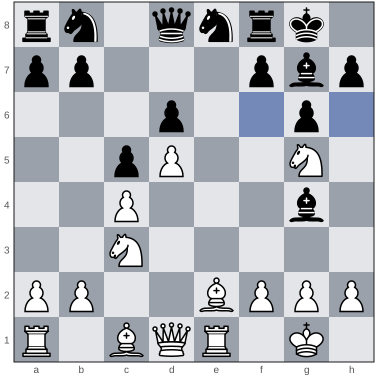
This is José Raúl Capablanca against Jacques Mieses, an exhibition game in Berlin, 1913. Black’s pawns on g6, f7 and h7 stand around the king; the bishop on g7 guards the dark squares f6 and h6. Black to move. Which capture should Black choose?
Show the answer
Bxe2, taking the light-squared bishop and keeping the bishop on g7.
Right. It is the engine’s first choice. The bishop on g7 keeps guarding the dark squares around the king.
The game went 11...Bxc3. After White takes back and the light-squared bishops are traded, look at what is left: White has a dark-squared bishop on c1, and Black has no bishop at all.
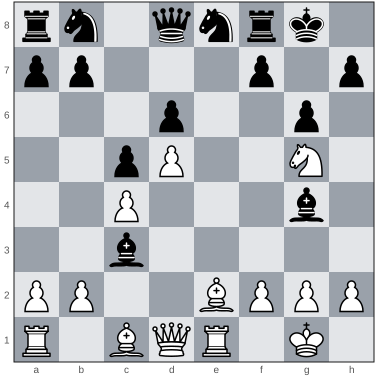
- 12. bxc3 Bxe2 13. Qxe2 Ng7 The knight goes to g7, the square the bishop has left.