Chess lessons › Chess strategy
Overprotection
Guard a strong point more times than it is attacked; its guards stand well and are free to act.
The idea
Guard a strong point more times than it is attacked.
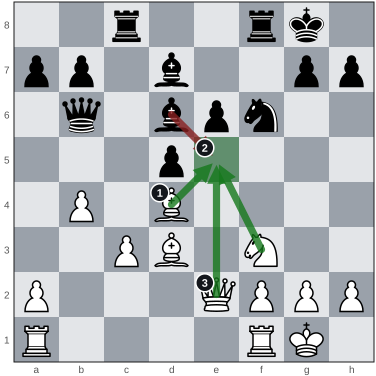
- The pawn on c3 and the knight on f3 guard the bishop on d4.
- Three white pieces guard e5, and only the bishop on d6 attacks it.
- With a guard to spare, the queen on e2 is free to go elsewhere.
In a game: Find your strongest square and give it one more guard than it needs.
How the lesson begins
Overprotection means guarding a strong point, such as a key square in the centre or an outpost, more times than it is attacked. Aaron Nimzovich made it one of the ideas of his book My System (1925 to 1927). The guards stand on good squares because of the point they guard, and if one of them is needed elsewhere, the point still holds.
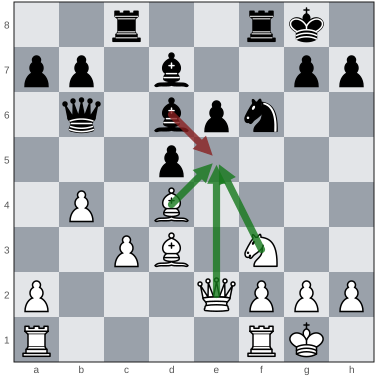
This is Nimzovich against Gersz Salwe, Karlsbad 1911. White has no pawn on d4 or e5 any more, but White still holds both squares: the pawn on c3 and the knight guard the bishop on d4. Three white pieces guard e5: the bishop on d4, the knight on f3 and the queen on e2. Only Black’s bishop on d6 attacks it.
Find the move
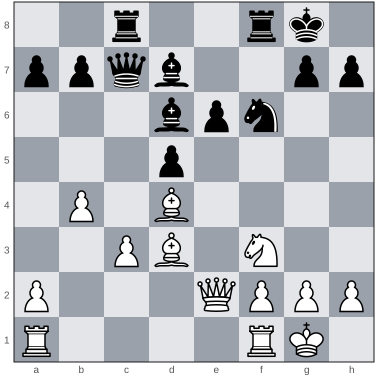
Black has just played 16...Qc7. White to move. Put a piece on the strong square.
A hint
Which square do three of your pieces guard?
Show the answer
17. Ne5
Ne5, which Nimzovich played, is one of the engine’s best moves. On e5 the knight is guarded by the bishop on d4 and the queen on e2, and only one black piece, the bishop on d6, attacks it. If Black takes it, another white piece takes back and stands on e5 in its place.