Chess lessons › Chess strategy
The principle of two weaknesses
One weakness can usually be held. Attack a second one far away, and the defence breaks.
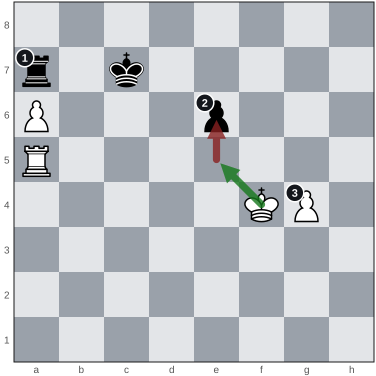
The idea
One weakness can be held, so make a second one far away from it.
- The pawn on a6 ties Black’s rook to a7, in front of it.
- Black’s king has gone to c7, so White’s king can attack the pawn on e6.
- The g-pawn can run as well: one king cannot guard both wings.
In a game: If one target holds firm, make a second one on the other wing.
How the lesson begins
A single weakness can often be held: the defender puts pieces in front of it or beside it, and waits. The principle of two weaknesses says: make a second weakness on the other side of the board. The defending pieces cannot be in two places at once.
This is José Raúl Capablanca against Frank Marshall, St Petersburg 1914. White has an extra pawn: a passed pawn on a5, with no black pawn in front of it or beside it. White to move.
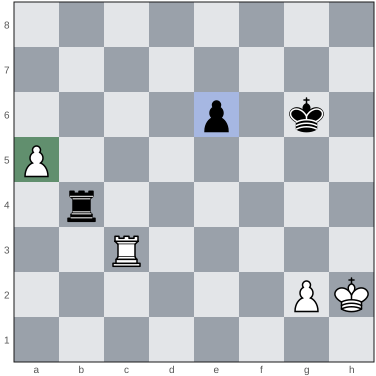
Find the move
White to move. Only three moves keep the win. Find one.
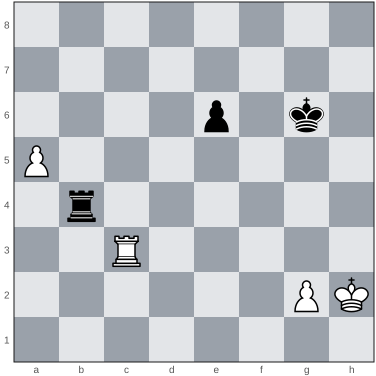
A hint
The rook on c3 can go behind the a-pawn, or attack the pawn on e6.
Show the answer
49. Ra3
Ra3, Capablanca’s move, puts the rook behind the passed pawn, where it supports the pawn all the way up the file. Re3, attacking the pawn on e6, and Rg3+ also keep the win. The tablebase, a list of the perfect result of every ending with few pieces, says every other move lets the win go.