Chess lessons › Chess strategy
The isolated queen’s pawn
A d-pawn with no pawn of its own colour beside it: active in the middlegame, a target once pieces come off.
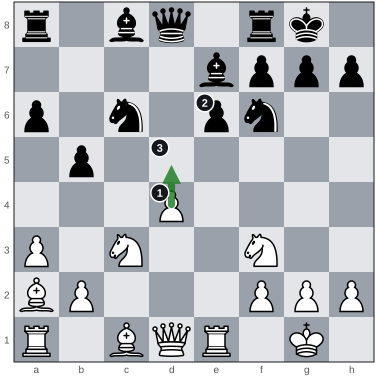
The idea
A lone d-pawn: active with pieces on, a target once they come off.
- d4 has no white pawn on the c-file or the e-file: it is isolated.
- Black’s pawn on e6 guards d5, the square in front of it.
- d5 is pushed anyway: it attacks the knight and opens lines.
In a game: Look at the files beside your d-pawn. No pawn of yours on the c- or e-file means it is isolated.
How the lesson begins
This is the Semi-Tarrasch Defence of the Queen’s Gambit Declined. Step through the moves. After the trades on c4 and d4, White’s pawn on d4 has no white pawn on the c-file or the e-file. It is an isolated queen’s pawn, often called the IQP. No pawn can defend it, so only pieces can.
But it is not simply weak. The c-file is open, and the e-file is half-open for White’s rooks: White has no pawn on it, Black has one. The d-file is half-open for Black’s rooks, aimed straight at d4.
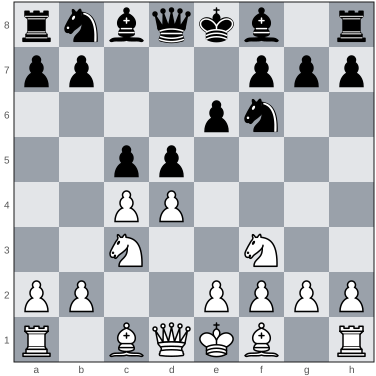
- 5. e3 Nc6 6. a3 dxc4 7. Bxc4 cxd4 8. exd4 White takes back with the e-pawn, and the d-pawn is isolated.
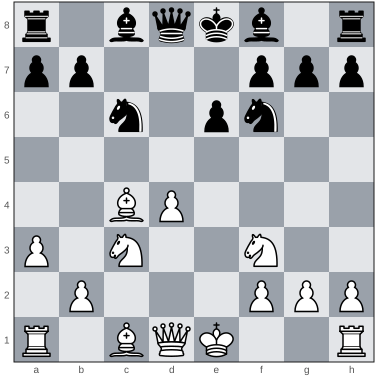
A question
Which file should Black put a rook on, to pressure the isolated pawn directly along it?
Show the answer
The d-file.
Right. Black has no d-pawn, so a rook on the d-file faces the isolated pawn at once.